

Welcome back, welcome back. Rico here.
If you’ve been following my journey for any amount of time, you know I’m a big NEOS fan. QQQI is my largest holding. SPYI is my portfolio glue. The 1256 contracts, the tax efficiency, the data-driven call writing — I’ve talked about why I trust their approach in video after video.
So when NEOS dropped two brand new “Boosted” versions of my two favorite funds back in February? Yeah. I paid attention.
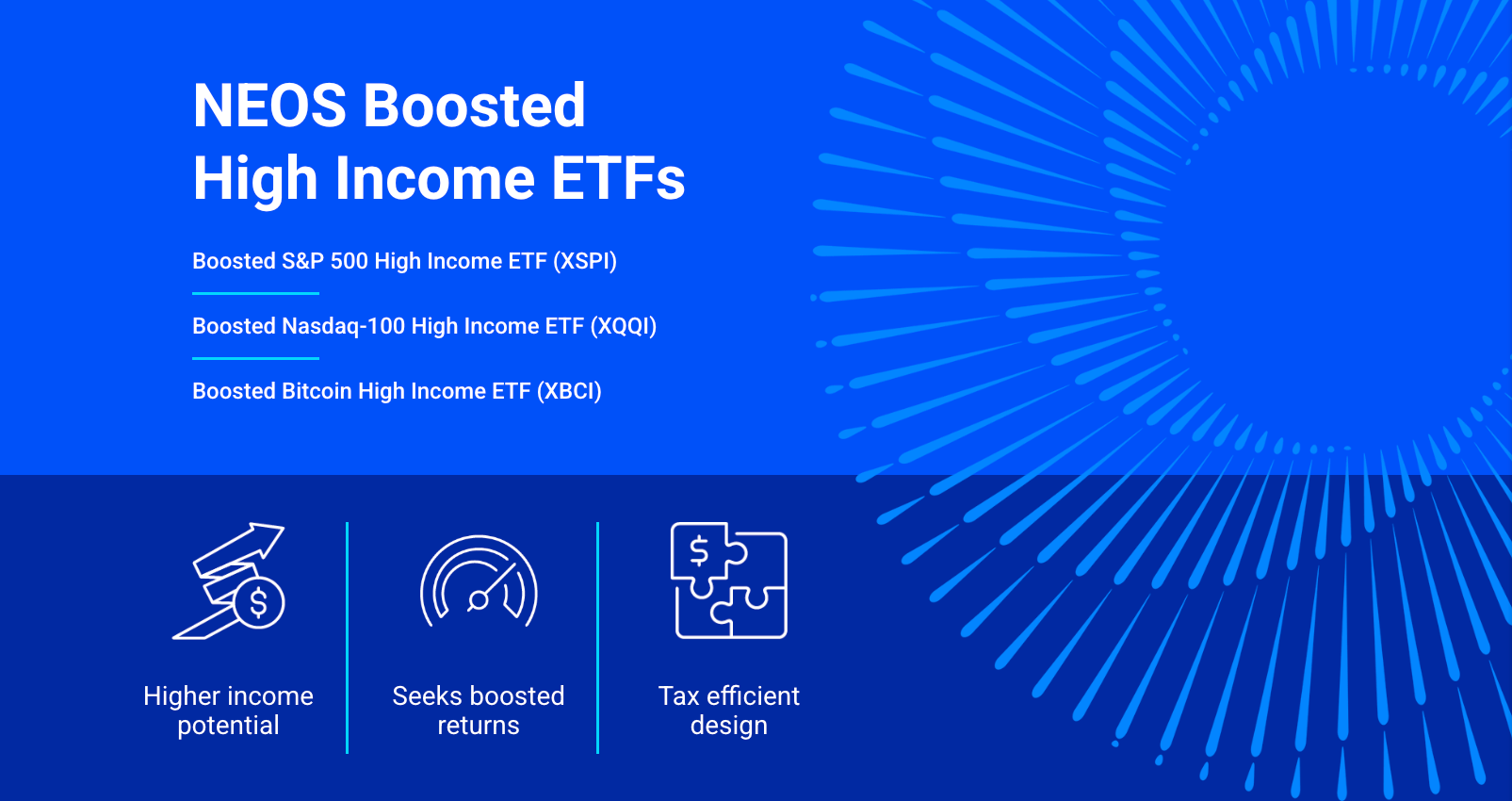
Today I’m breaking down XSPI and XQQI — what they are, how they compare to the originals, and what I’m personally doing with them. This is also the topic of this week’s YouTube video, so if you want the full visual breakdown with charts and side-by-side comparisons, keep an eye out for that dropping soon.
Let’s get into it.
Quick disclaimer — I’m not a financial advisor. Everything here is what I’m personally researching and doing in my own portfolio. This is educational, not advice. Always do your own research before investing your hard-earned money.
What Are XSPI and XQQI?
Both launched on February 2nd, 2026. So we’re looking at roughly three months of live data. That’s it. I want to be upfront — this is early. Really early.
XSPI is the NEOS Boosted S&P 500 High Income ETF. Think of it as SPYI’s bigger sibling. Same foundation — holds S&P 500 stocks, writes covered calls using SPX index options, uses 1256 contracts for tax efficiency. But XSPI adds a synthetic options layer that gives it approximately 150% notional exposure to the S&P 500. Not through daily-reset leverage. This is done through longer-dated index options.
XQQI is the same concept for the Nasdaq-100. QQQI’s bigger sibling. Same stock portfolio. Same covered call strategy with NDX index options. Same 1256 tax treatment. Boosted to approximately 150% notional exposure.
NEOS also launched a third boosted fund — XBCI, the boosted Bitcoin version of BTCI. I’m not covering that one today. Personally it’s less compelling to me because BTCI already has a higher yield and gives direct Bitcoin exposure. The boosted Bitcoin version just isn’t calling my name the same way.
The Key Numbers
XSPI: Distribution target of 15-18% annualized. Current distribution rate around 17%. Net assets roughly $37 million. Monthly distributions. Expense ratio: 0.98%.
XQQI: Distribution target of 19-23% annualized. Current distribution rate around 20.6%. Net assets around $93 million — significantly more, which tells me investors are gravitating toward the Nasdaq version. Also monthly. Same 0.98% expense ratio.
Now here’s the thing I want to flag immediately. SPYI and QQQI both have an expense ratio of 0.68%. These boosted versions come in at 0.98%. That’s a 30 basis point jump. On a $100,000 position, that’s an extra $300 a year. Does the extra yield justify the extra cost? That’s the central question.
Do the Holdings Actually Match?
Before I looked at performance, I wanted to look under the hood. If these funds are supposed to track the S&P 500 and Nasdaq-100, I want to make sure they actually do.
Short answer — yes.
XSPI’s top holdings mirror SPY almost identically. Nvidia, Apple, Microsoft, Amazon, Alphabet, Broadcom, Meta, Tesla — all within a percentage point of SPY’s weightings. The one difference is an SPX index call option position sitting at about 5.2% of the portfolio. That’s the boosted component. That’s the synthetic exposure showing up.
Same story with XQQI and QQQ. Top holdings are nearly identical. The NDX call option position at about 6.8% is where the boost lives.
The equity side is not a mystery. These hold the same stocks. The differentiation is entirely in the options strategy.
Performance Since Launch — Price Return vs. Total Return
This is where it gets interesting. And I want to break this into two views because for income investors, the distinction matters.
Price return since launch (share price only, no distributions):
QQQ leads at about +7.6%. SPY at +3.7%. XQQI at +2.1%. QQQI at +0.65%. SPYI at -0.7%. XSPI at -1.1%.
On price alone, the boosted versions are performing in the same neighborhood as the originals. XQQI is slightly ahead of QQQI on price. XSPI is slightly behind SPYI. But both boosted funds are paying out higher distributions, which naturally pulls the price down more.
Total return since launch (distributions included):
This is the number that matters. QQQ at +7.7%. XQQI right there at +7.6%. Almost identical. That is impressive for a fund paying out a 20% annualized distribution. QQQI at +4.3%. SPY at +4%. XSPI at +3.2%. SPYI at +2.3%.
On the Nasdaq side, XQQI is meaningfully outperforming QQQI on total return. On the S&P side, XSPI is outperforming SPYI as well.
But — three months is not a trend. Three months during a recovery from the tariff selloff is a very specific market environment. The boosted exposure helped these funds snap back harder because of that 150% notional exposure. In a sustained downturn, that same leverage works against you. We saw all of these funds dip 10-15% during the April correction. The boosted versions went a little deeper.
Early returns are encouraging. But I’m treating this as data, not a conclusion.
So What Am I Doing?
Here’s where I land.
The distribution targets are attractive. XSPI at 15-18% versus SPYI’s 11-12%. XQQI at 19-23% versus QQQI’s 13-14%. That’s meaningful extra income.
But it comes with a higher expense ratio. It comes with amplified downside risk during corrections. And these funds are three months old — no long track record, no full market cycle data, no recession test.
So I’ve opened very, very small test positions in both XSPI and XQQI. Just enough to have skin in the game. Real distributions hitting my account. Real NAV movement I can track with actual dollars — not just charts on a screen.
I’m going to hold these test positions and report back. I want to see if the distributions stay consistent. I want to see if the NAV erodes faster than the originals over time. Because that’s the real question — does the extra yield come at the cost of capital erosion, or does the boosted market participation offset it?
I’ve learned that lesson the hard way with other high-yield positions. Every dollar has a job — and one of those jobs is to not disappear.
QQQI and SPYI remain my core NEOS positions. XQQI and XSPI are in the testing bucket. If they prove themselves over the next six to twelve months, I could see increasing the allocation. But I’m not rushing. And when the data comes in, I’ll do a full follow-up.
I Want to Hear From You
Are you looking at these? Already in? Skeptical? Sticking with the originals? Drop a comment or reply to this post — I read every single one.
And if you haven’t already, check out the Freedom Calculator — it’s completely free and it can help you figure out your freedom number and timeline. Link is right here on Substack.
If it doesn’t challenge you, it doesn’t change you. Messy action is better than no action.
Talk soon — BOOM.
— Rico
I currently hold SPYI & QQQI, but not their boosted versions. I'm happy with what I have for now, and want to wait until there's more time and data on newer ETF'S. Like you, I've learned from past mistakes, therefore cautious and dig a little to see what happens to NAV on anything over 12- 14% returns before I jump in. A high distribution/yield can overcome some erosion of NAV, but you can take less risk on a lower yield with the same return. I look forward to your updates on NEOS new funds!