

I got a comment this week that I see all the time. And I don’t think the person was being confrontational — they were genuinely asking a good question.
“If there’s a downturn in the market, and everything falls, what happens to your dividend income?”
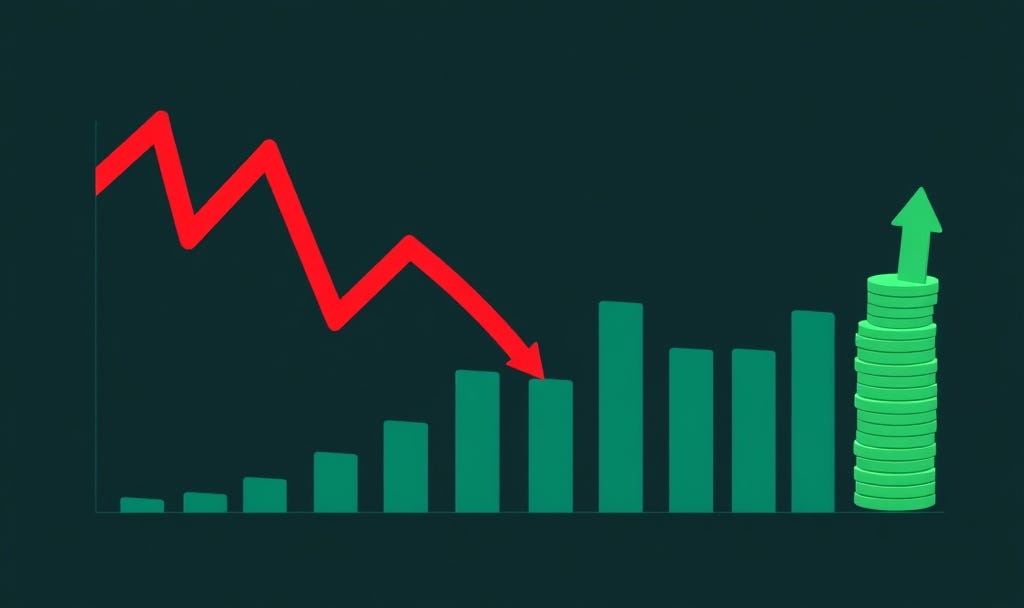
It’s a fair ask. And the answer is actually the opposite of what most people think. In a downturn, income doesn’t disappear. In fact, sometimes it increases. But here’s the thing — most people don’t understand why because they don’t know how these ETFs actually generate income in the first place.
So let me break that down. No jargon. No complicated finance-speak. Just how it actually works.
The Real Problem: Nobody Explains How These Work
If you’re asking this question, you’re not uninformed — you’re actually thinking clearly. The problem isn’t you — it’s that nobody’s explained how these income ETFs work.
Most people think income comes from company profits. Dividends, right? Company makes money, shareholders get paid. That logic is solid. But here’s where it breaks down.
The ETFs I own — QQQI, SPYI, CHPY — they don’t primarily generate income from dividends. They generate income from options premiums. And that’s a completely different animal.
When you own an income ETF like JEPI, you’re receiving distributions. Regular, monthly payments. But those distributions aren’t coming from Apple or Microsoft or any company in the S&P 500 paying dividends.
They’re coming from premiums. Options premiums.
Think of a premium like this: it’s the price someone pays you for the right to do something in the future. You’re collecting that price upfront. That’s your income.
Covered Calls: How Premiums Actually Get Generated
Here’s how this works in practice.
Imagine you own 100 shares of Apple. You paid $150 a share. Apple’s trading at $155. You own it outright.
Now someone comes to you and says: “I’ll pay you $2 per share if you agree that I can buy your shares from you at $160 anytime in the next month.”
You’re collecting $200 upfront for that promise. That $200 is the premium. It’s income. It comes into your account. And you didn’t have to sell anything.
If Apple stays below $160 by the end of the month, the other person walks away. Their option expires worthless. You keep your shares and you keep the $200 premium. Then you do it again next month.
That’s a covered call. You own the shares (covered), you sell someone the right to call them away from you (call), and you pocket the premium.
This is how JEPI works at scale. JPMorgan owns hundreds of millions in S&P 500 stocks. Every month, they sell call options on those holdings. They collect premiums. That premium is your distribution. Your income.
Puts: Collecting Premium on the Other Side
But here’s where it gets interesting. Some of these income ETFs don’t just sell calls. They also sell puts.
A put is the opposite side of the trade. You’re selling someone the right to sell you shares at a certain price. You’re collecting a premium for agreeing to that risk.
Think of it this way: if you sell a put on Apple at $150, you’re saying “I’ll buy your shares from you at $150 if they fall below that.” In exchange, someone pays you a premium upfront for that insurance.
Some funds — like REX Shares — layer in put spreads along with call spreads. They’re collecting premiums on both sides. The mechanics are slightly different, but the principle is the same: they’re getting paid for taking on risk. And that payment is income.
The benefit? Puts can help hedge downside. You’re not just collecting income — you’re also getting some protection built in. That’s why some of these strategies are more defensive. They’re generating income and managing risk.
Why Premiums Exist: The Key Insight
Now here’s the critical part. Premiums exist because of uncertainty. Not because a company is healthy or sick.
When you sell someone the right to buy Apple at $160, they’re paying you for the possibility that Apple could jump above $160. They’re buying protection. They’re buying the upside if it happens.
The higher the uncertainty, the higher the premium. Someone will pay more money for that right when the market is chaotic, volatile, and unpredictable.
In a calm market? Premiums are small. People aren’t worried, so options aren’t valuable.
In a volatile market? Premiums spike. People are nervous, they want protection, they want opportunity. They’ll pay more.
Here’s the thing nobody tells you: downturns are volatility events. And volatility is where premiums come from.
This is the game-changer. This is why income doesn’t disappear when markets fall.
2022: The Real-World Proof
Let me show you what actually happened.
In 2022, the market had a brutal downturn. The S&P fell 18% for the year. The Nasdaq fell even harder — down in the mid-20s. Terrible year for buy-and-hold investors.
But here’s what happened to JEPI. Yes, the share price fell. Of course it did — it owns S&P 500 stocks. Starting the year at $60.99, by September 2022 it was down to $51.23. That’s a 16% hit. Real money on paper. Painful to watch.
But you know what else happened? Distributions kept getting paid. Every single month. Because traders were still trading. Options were still being written. Volatility was through the roof. Premiums were huge.
Look at the actual distribution amounts:
The Calm Months (Feb-Jun 2022): $0.38 to $0.46 per share per month.
The Volatility Spike Months (Jul-Dec 2022):
July: $0.62
September: $0.56
October: $0.48
November: $0.61
December: $0.61
The volatility was the thing generating the income. As the S&P fell, premiums got more valuable, not less. The fear was creating the opportunity.
A growth investor in 2022 was in a bind. Stock prices fell. If they needed income, they’d have to sell at the bottom — which is the worst possible time to sell. They’re forced to sell low.
An income investor with JEPI? Didn’t sell a single share. Collected distributions every month. Watched the volatility spike. Watched the premiums spike. Watched the income flow in. It’s not the same as being up for the year. But structurally, I’m not in crisis.
That’s the real difference.
How Fund Managers Pull This Off
You might be wondering: why don’t I just do this myself?
I tried writing my own call options. Once. It was tedious, time-consuming, and the math didn’t pencil out. I’d have to monitor positions constantly, roll them, manage expirations, handle edge cases. For the amount of money it would make me, it wasn’t worth the hours.
Fund managers have scale. They own hundreds of millions of dollars in holdings. They can write thousands of contracts. They can automate the rolling process. They can afford to do this efficiently because they’re doing it for millions of dollars, not thousands.
When you buy JEPI, you’re essentially hiring JPMorgan to do that work. You pay them a small fee (baked into the expense ratio), and they handle the whole operation. They collect premiums, they roll contracts, they distribute the income.
I just... receive it. Every month. It hits my account.
That’s the trade-off. Less control, more convenience. And for me, it’s the right choice.
The Key Question: What Happens to My Share Price?
Okay, so yes. In a downturn, my share price in JEPI falls because it owns S&P 500 stocks, and the S&P falls. My shares are worth less on paper.
Look at the actual numbers. In January 2022, JEPI closed at $60.99. By September 2022 — the worst month of the downturn — it was down to $51.23. That’s a 16% decline. By February 2023, it was sitting at $53.79. So roughly a 12% decline over about 13 months.
Is that painful to look at? Yeah. But here’s what didn’t happen during that time: I didn’t have to sell a single share. I didn’t watch my income disappear. I didn’t panic-sell at the bottom.
For comparison, the S&P 500 itself fell 18% in 2022. JEPI’s price declined less than that. But more importantly — I was collecting monthly distributions the entire time. Real money hitting my account. Every single month.
Compare that to someone who owns SPY (the regular S&P ETF, no options overlay). In 2022, they’re down 18%. If they need to live off their portfolio, they’re forced to sell. They’re selling at the bottom. They’re locking in losses.
Me? I’m not selling. I’m living off the distributions. The distributions might be smaller because volatility eventually calms down and premiums compress. But I’m not forced to do anything. I can wait. I can let it recover.
That’s the structural difference for me. It’s not that my income is immune to downturns. It’s that I don’t have to sell in downturns.
This is why income investing is structurally different from growth investing. One forces you into decisions. The other lets you stay disciplined.
Why This Still Works (And Will Keep Working)
The last piece: why does this work at all?
Because markets are always volatile. Always. Even in the longest bull markets, there are corrections, there are days of fear, there are earnings surprises.
As long as there are traders and investors, there will be hedging. As long as there’s hedging, there will be demand for options. As long as there’s demand, premiums will exist.
I don’t need a bull market for this strategy to work. I need trading. And trading is going to happen whether stocks are up or down.
That’s it. That’s the insight.
The Bigger Picture
If you’re asking “what happens to my income in a downturn?” — you’re asking the right question. But the answer depends entirely on how your income is generated.
If you’re relying on company dividends, yes, a downturn can hurt. If you’re relying on options premiums and volatility, a downturn can actually improve your opportunity.
That’s not magic. That’s not luck. That’s understanding the structural difference between dividend investing and options income investing.
I cover this in much more depth in the video version of this article, where you can see the actual 2022 data visualized. But the core principle is this: every dollar has a job. Some dollars buy you food. Some buy you shelter. But the dollars hired to generate income have a very different job than most people think.
Your Move
If you want to understand your income strategy better — or build one from scratch — that’s what this community is about.
I share my full portfolio breakdown, real numbers, wins and losses, and walk through the frameworks I use to think about income investing. There’s no “one right way,” but there are principles that work regardless of the market environment.
The Freedom Calculator (free to all subscribers) helps you figure out your actual freedom number — how much passive income you need to stop trading time for money. It’s worth running through, whether you’re just starting or you’ve been at this for years.
Join the community at my Substack, and let’s talk strategy together.
Disclaimer: I’m not a financial advisor. Everything here is based on my personal research and experience. Always do your own research and consult with a professional before making investment decisions.
Ready to go deeper?
Use the Freedom Calculator to figure out your number.
Join the community to talk strategy with other income investors.