

In 2018, I made a decision that made complete sense at the time.
I partnered with some friends and we went in on a portfolio of rental properties together. Thirty-plus units. I put in somewhere between $200,000 and $250,000. Real estate felt safe. Tangible. The kind of investment you could actually see and touch — not some number flickering on a screen.
You know the pitch. Passive income. Appreciation. Tax advantages. All the things you hear at every dinner party and in every finance podcast.
The reality was different.
Maintenance calls that never stopped. Costs I didn’t anticipate. Property taxes that hit harder than expected. The kind of operational friction that comes with managing a large portfolio of properties across multiple locations with multiple people involved. When we eventually sold everything, I walked away with somewhere between $75,000 and $100,000 back.
On a $200,000 plus investment.
I’m not bitter about it. I don’t blame my partners — we all went in with good intentions and we all came out wiser. And I still own the first rental property my wife and I bought together in Las Vegas in 2017. That one stays.
But here’s what genuinely gets to me.
I was at my earning peak. Late 30s, early 40s. A senior executive with real capital to deploy. And not one person — not a colleague, not a mentor, not a financial advisor — sat me down and said: “Before you tie up $200,000 in rental units, let me show you what the market actually does over time.”
Not one.
So I’m going to be that person for you today.
The thing most people get wrong about stocks
Let me address the objection I hear constantly — and one I used to believe myself.
“The stock market is gambling.”
I get it. When you’re watching prices move up and down every day, it feels chaotic. It feels speculative. It feels like the opposite of something solid and real.
But here’s what I know now that I didn’t know then. When you invest in a broad index fund — something that tracks the Nasdaq-100 or the S&P 500 — you’re not betting on a single company’s fate. You’re buying a small ownership stake in the most dominant companies in the world. Apple. Microsoft. Google. Amazon. The businesses that run the global economy.
That’s not gambling. That’s ownership.
And when you stay in long enough — through the dips, through the scary headlines, through the years that test your patience — the math becomes undeniable.
What $200,000 in QQQ would have done
Let me show you the actual numbers, because this is where it gets real.
QQQ is the ETF that tracks the Nasdaq-100. It’s one of the most widely held funds in the world, and its annual return history is publicly available. Here’s what those years looked like, and what would have happened to a $200,000 investment made at the start of 2018.
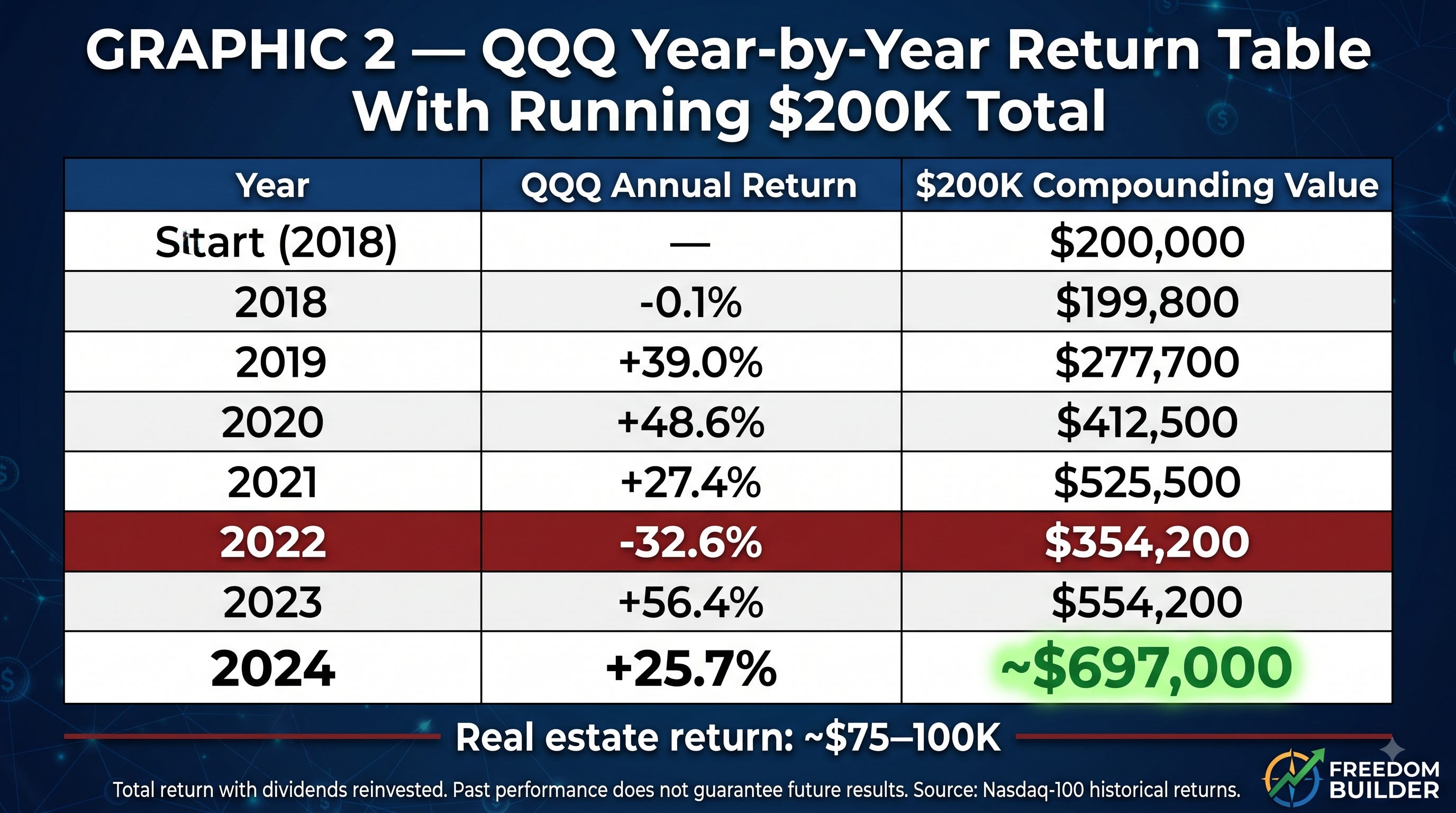
Then 2022 hit. Down 32%. The position dropped to around $354,000. That’s the year that shakes people loose — and it’s exactly the year you have to stay in.
Because 2023 came back with 56% growth, pushing the position back to roughly $554,000. And 2024 added another 26%, bringing the final total to approximately $697,000.
From $200,000 to $697,000. No tenants. No maintenance calls. No partner meetings about a leaky roof. No operational overhead of any kind.
Now — I want to be honest with you, the way I always try to be. Past performance doesn’t guarantee future results. QQQ had a brutal 2022. Anyone who bailed that year locked in a real loss. The only way this math works is if you stay the course and let time do its job. That’s not easy. But it is simple.
And it gets more interesting from here.
The upgrade: from QQQ to QQQI
QQQ is a growth fund. It appreciates beautifully over time, as we just saw — but it generates almost no income. The dividend yield is less than half a percent. So you’re building wealth in the background, but you’re not building cash flow you can actually live on.
That’s where my thinking has evolved significantly over the last few years.
In January 2024, NEOS launched QQQI — the Nasdaq-100 High Income ETF. It’s now my largest holding, and it’s the fund I wish had existed a decade ago.
Here’s the concept. QQQI holds essentially the same underlying exposure as QQQ — the Nasdaq-100, the same 100 companies. But layered on top of that is a covered call options strategy using 1256 contracts, which generates monthly income and does so in a tax-efficient way that most covered call funds don’t bother to optimize for.
The result is a distribution yield around 14%, paid every single month.
So here’s the hypothetical I want you to sit with. What if someone had held QQQ from 2018 through the end of 2024 — building that position up to roughly $697,000 — and then in early 2025 transitioned that into QQQI?
At a 14% yield on $697,000, that position would be generating approximately $97,000 a year in passive distributions. About $8,100 every month. Hitting the account whether you’re working, traveling, or sleeping.
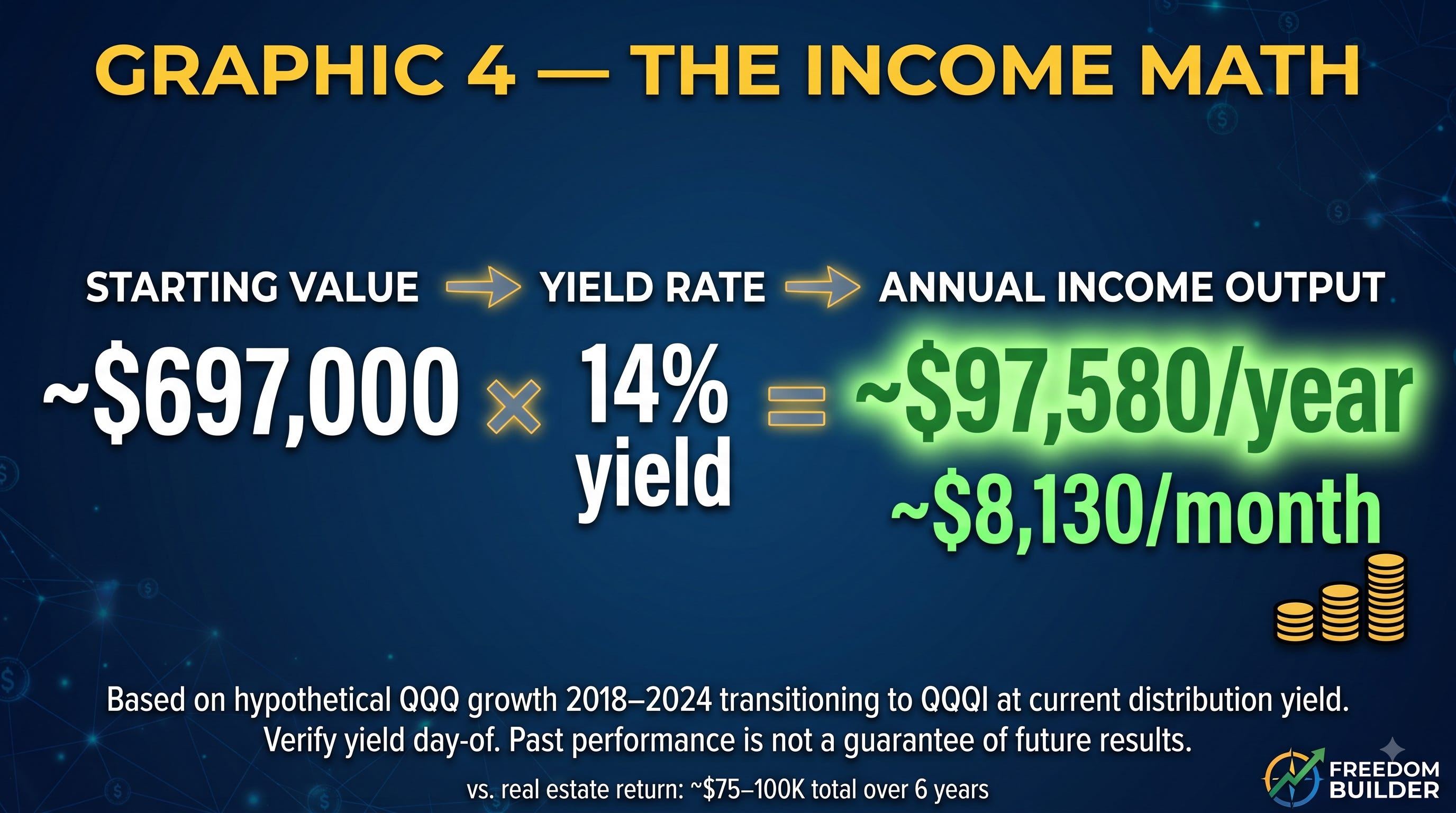
That is what every dollar having a job actually looks like in practice.
I want to be clear — this is a hypothetical built on historical data, and QQQI didn’t exist in 2018. The yield fluctuates. The total return will vary. This isn’t a promise, it’s a principle: index-based exposure combined with an income overlay gives you both growth potential and cash flow. That combination is what I’m building toward now. And it’s what I wish I’d understood ten years earlier.
What I’d actually do starting over today
So let’s get practical. Whether you’re 35, 45, or 55, here’s the philosophy I’d follow if I were starting from scratch.
Income over appreciation. I’m not chasing price. I’m building cash flow. Every dollar I invest needs to have a job — and that job is to send me more money. Appreciation is a bonus, not the strategy.
Broad indexes over concentrated bets. No single stocks. No sector gambles. No speculative plays hoping to catch lightning in a bottle. I want exposure to the biggest, most dominant companies in the world, through structures that pay me while I hold them.
The 3-Bucket System. This is the framework I organize everything around, and it’s designed to work in any market environment.
The first bucket is the Income Engine — the higher-yield, more aggressive positions that generate cash flow today. These are the workhorses.
The second bucket is the Core Foundation — the anchor of the portfolio. QQQI and SPYI live here. Broad index exposure with monthly income and tax efficiency built into the structure. Stable, durable, and designed to compound over decades.
The third bucket is the Defensive Moat — the shock absorbers. Assets that behave differently when markets get ugly. Gold exposure, energy infrastructure, real assets. These aren’t exciting. That’s exactly the point.
Together, the three buckets cover growth periods, downturns, inflation, and uncertainty. You’re not betting on one market environment. You’re building a portfolio that can survive all of them.
Start earlier than you think you need to. This is the one that keeps me up at night. If someone had shown me this framework at 38 — when I had real capital to deploy and real income coming in — I don’t think I would have worked until 2023. I think I would have walked away years earlier.
It’s not too late
Here’s what I want you to hear before you close this article.
The best time to plant this tree was ten years ago. The second best time is today.
Your earning peak — whenever it was or whenever it’s coming — is the most important capital deployment window of your financial life. That’s the moment when income is highest, expenses are (hopefully) manageable, and time is still on your side. Use it deliberately. Give every dollar a job.
And if you feel behind — if you’re reading this thinking you’ve already missed your window — I want to push back on that directly. I know what it feels like to lose money. I know what it feels like to look back and see the decisions you’d make differently. I went through a Chapter 13 bankruptcy in 2009. I lost everything and spent five years repaying every dollar under legal supervision. If I can build a portfolio generating over $160,000 a year in passive income from that starting point, the window is not closed for you.
It is never too late to redirect your dollars toward a better outcome.
Where to go from here
If this resonated with you and you want to start putting numbers to your own situation, my Freedom Calculator is completely free. It helps you figure out your actual freedom number — how much passive income you need, how long it realistically takes to get there, and what your path looks like based on where you’re starting from. No fluff, no upsell. Just the math. You can find it linked in my profile.
If you’re ready to go further and actually build your first income portfolio, the Freedom Builder Bootcamp gives you a 30-day roadmap to get your foundation in place. It’s the structure I wish someone had handed me when I was starting out — the frameworks, the thinking, the sequence of decisions that actually matter.
And if you found value in this article, the best thing you can do is share it with someone who needs to read it. Someone in their 30s or 40s who’s still figuring out where their money should go. Someone who thinks the stock market is gambling. Someone who’s been sitting on capital and hasn’t pulled the trigger yet.
That’s who I wrote this for.
I’m Rico Nasol — a former creative executive who retired in 2023. I share my real portfolio, real income numbers, wins, losses, and everything I’m learning as I build my income snowball in public. Subscribe to follow along.
Nothing in this article is financial advice. Always do your own research before investing your hard-earned money.
I'm 76 y.o. I don't have time on my side. Yet I find your posts and videos very helpful. Using some of your ideas and also some ideas I have gotten from Viktoria Finance I have put a portfolio together that pays enough monthly to o cover my apartment rent and my groceries. I am going to see my ow t that portfolio does over the next 6 months and then reevaluat. Thank you for your insights and inspiration.
Richard from Minnesota
Really liked this. I’m 56 and pretty new to income ETFs, so I laughed when you said you wrote it for people in their 30s and 40s.
What clicked for me was realizing I had money sitting around that made sense to keep in cash at one point, but doesn’t necessarily make sense anymore. Learning about income ETFs showed me that same money could potentially generate more income than my full-time job.
Better late than never.